Wiesel 1A4 MK20
- volkerbattke
- 2. Apr.
- 4 Min. Lesezeit
A Weasel with Teeth — The History of the Wiesel
Few vehicles in the Bundeswehr's inventory have earned as much admiration for sheer ingenuity as the Wiesel. Small, agile, and deceptively capable, it was named after the weasel — an animal that is notoriously difficult to spot and even harder to catch. That philosophy shaped every design decision made over the vehicle's long and winding development history.

Work on what would eventually become the Wiesel began as far back as 1969, when West German MOD planners and the Heeresamt began studying a replacement for the aging Kraftkarren (KraKa). The project was developed in close collaboration with Porsche KG — later Porsche AG from 1972 onwards — who brought their engineering expertise to bear on the challenge of creating a genuinely air-transportable armoured weapon carrier. The development process was anything but straightforward; it stretched across nearly two decades before the first series-production vehicles were delivered to the Bundeswehr in the late 1980s.
The Wiesel was conceived specifically for the Luftlandetruppe — the German airborne forces — who needed a vehicle that could be slung beneath a helicopter or loaded into a transport aircraft, yet still pack a meaningful punch on the battlefield. The result was a compact tracked vehicle measuring just 3.31–3.55 m in length and 1.82 m in width, crewed by two to three personnel. Production of the Wiesel 1 ran until 1993.
The 1A4 MK — A Continuously Evolving Platform
The Wiesel was never a static design. Over its service life, the platform underwent a series of progressive upgrades that reflected the Bundeswehr's evolving operational requirements. The MK (Maschinenkanone) variant is armed with the 20 mm Rh 202 automatic cannon, giving it a potent anti-infantry and light vehicle capability.
The upgrade path leading to the 1A4 designation is particularly telling. The Wiesel 1A1 MK received the Autonomes Optronisches Zielsystem (AOZ 2000), significantly improving its night-fighting capability. Subsequent variants continued to refine the platform until the integration of the FüInfoSysH - the Führungs- und Informationssystem des Heeres, the German Army's command and information system - into the Wiesel 1A2 MK, which triggered the redesignation to Wiesel 1A4 MK. The first Wiesel 1A4 MK vehicles were fielded in 2008, representing the most digitally integrated iteration of the original Wiesel 1 lineage.
Building the Model — From Research to Real-Time
Research & Reference: PureRef
Every good model begins long before the first polygon is placed. The research phase for the Wiesel 1A4 MK20 relied heavily on PureRef, the industry-standard reference image organiser used by concept artists and 3D modellers alike. PureRef allows the artist to gather images from the web, drag them directly from the browser, and arrange them into a structured canvas that stays on top of all other windows - keeping references visible at all times without interrupting the modelling workflow.

For a vehicle like the Wiesel, where publicly available photographic documentation is relatively limited, building a comprehensive PureRef board is essential. Images were sourced from military archives, museum photographs, and open-source documentation, then organised by vehicle section - hull, running gear, turret, cannon mount, and interior details. PureRef's annotation and cropping tools allowed specific details such as the MK 20 cannon mount geometry and the AOZ 2000 optics housing to be isolated and cross-referenced efficiently.
Modelling: Blender
With the reference board established, modelling began in Blender. The Wiesel's compact, boxy silhouette is deceptively straightforward - the real challenge lies in the track assembly, the angular hull transitions, and the distinctive cannon mount geometry.
The workflow followed a standard hard-surface approach:
Blockout phase - establishing the primary volumes of the hull, superstructure, and turret using simple mesh primitives, constantly cross-checked against the PureRef board.
Secondary detail pass - adding panels, bolt heads, vision ports, and the characteristic angular armour slopes of the Wiesel 1 hull.
Low-Poly bake with bevel shader - the model was prepared for baking normal and ambient occlusion maps, capturing fine surface details.
rigging: the wheels, tracks, turret and cannon were set up.

Texturing: Substance Painter
The baked maps were imported into Adobe Substance Painter for the texturing phase. The Wiesel 1A4 MK20 presented an interesting texturing challenge: German Bundeswehr vehicles of this era typically wear a three-tone NATO camouflage scheme of dark green, black, and brown, applied with soft, irregular edges.
The texturing process proceeded as follows:
Base material layers - steel and aluminium materials were applied to the respective mesh components using Substance's physically based rendering (PBR) workflow.
Weathering - dirt accumulation, paint chipping, rust streaking, and exhaust staining were added progressively using layer masks and smart materials, referencing the PureRef board throughout to ensure plausible wear patterns for a vehicle of this type and age.
Decals - Bundeswehr tactical markings and unit insignia were placed as dedicated decal layers, allowing non-destructive repositioning.

Real-Time Setup: Unreal Engine
The final model was brought into Unreal Engine for real-time presentation. The setup prioritised visual fidelity while maintaining a polygon and draw-call budget appropriate for interactive use.
Key steps in the Unreal setup included:
Material instances - a master material was created with exposed parameters for decal opacity, enabling rapid iteration without re-importing assets.
Blueprint rigging - the wheels, tracks, turret and cannon were set up as separate skeletal components within a Blueprint actor, allowing independent rotation to be driven procedurally or via animation.
Lighting validation - the model was evaluated under multiple HDRI lighting conditions to verify that the PBR materials responded correctly across different environments, from overcast European skies to harsh midday sun.

Closing Thoughts
The Wiesel 1A4 MK20 is a rewarding subject precisely because of its contradictions - a vehicle that is tiny yet formidable, simple in silhouette yet complex in detail. Recreating it faithfully demanded careful research, disciplined modelling, and a texturing approach grounded in real-world reference.


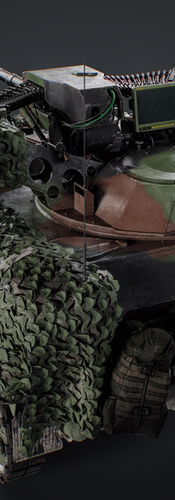

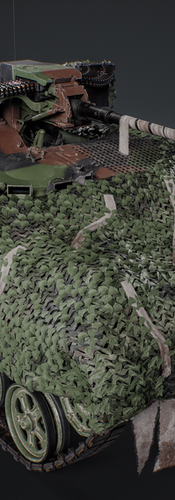




Wiesel 1A4 MK20 - gallery © 2026 cantaloupe GmbH
The result is a model that does justice to one of the Bundeswehr's most distinctive and characterful vehicles - a platform that, even as it approaches the end of its service life, continues to capture the imagination.


Kommentare